800.979.3177
 +1.412.785.7671
Google AI Mode Is Coming: What Does This Mean For Your Website?

Table of Contents
- Introduction
- Search Is Moving Toward AI-Generated Answers
- AI Overviews Already Show the Direction Google Is Going
- AI Mode Changes the Structure of Search Results
- Website Traffic Patterns Are Already Shifting
- Authority Signals Matter More Than Ever
- Original Information Gains Value
- Branding Becomes a Critical Search Strategy
- The Next Phase of Search
- Are You Ready for AI Mode?
- Key Takeaways
Search behavior has changed. A growing number of users no longer scroll through a long list of links to find answers. Instead, they receive responses generated directly by artificial intelligence. Google is pushing this change forward through their AI Mode, a new search experience now appearing more often for users in the United States during testing.
This has real implications for website owners, publishers, marketers, and anyone who depends on search traffic.
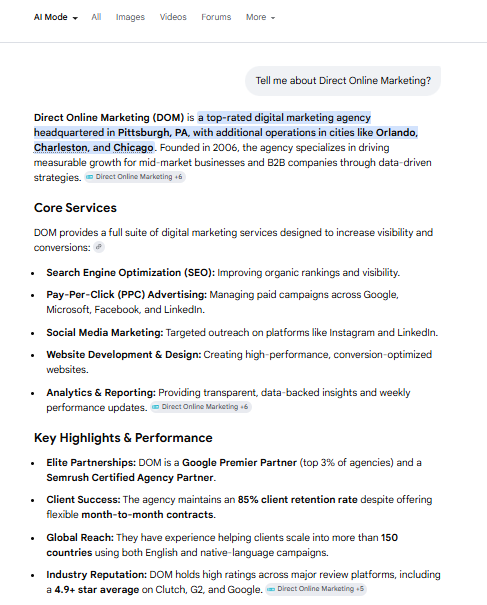
Example of Google AI Mode:
Search Is Moving Toward AI-Generated Answers
Traditional Google search shows a list of results. Many people know this format as the familiar page of blue links.
AI Mode introduces a different structure. Users type a query. Google generates a detailed response powered by artificial intelligence. That response pulls information from multiple sources and summarizes it into a single answer.
Links still appear, in a way, but the format looks different.
Instead of a long list of results, users see a smaller set of citations placed inside or beside the AI response. The AI system acts as an intermediary between the user and the websites providing information.
For many queries, the user receives enough information directly in the AI response. No need to open another page.
That changes how traffic flows across the internet.
AI Overviews Already Show the Direction Google Is Going
AI Mode builds on the foundation created by AI Overviews.
AI Overviews appear at the top of many search results pages today. The feature generates a summarized answer to the query and lists a few supporting sources.
Data from multiple analytics platforms shows a significant decline in website clicks after AI Overviews appear for a query. Some industry measurements show click-through rates dropping by roughly 42 percent in those cases.
Users still read the information but many stop at the summary.
Publishers are feeling the difference.
Fewer clicks means fewer pageviews. That impacts ad revenue, affiliate sales, newsletter signups, and product discovery.
The coming AI Mode will expand that pattern even further.
AI Mode Changes the Structure of Search Results
Here are some examples of how AI Mode looks compared to traditional Google search results.
Here is a search for Good Pizza Near Me on Traditional Google Search:

And here is that same search taking place within Google AI Mode:

As you can see, different information, different suggestions, and different links (if any) are suggested directly within the search results.This will have a major impact on all websites.
Website Traffic Patterns Are Already Shifting
Publishers across industries have begun reporting lower traffic from informational queries. Articles that once generated large amounts of search traffic now receive fewer visits.
The reason is simple: Users get answers earlier in the search process.
AI systems summarize information from several sources at once. The need to open multiple tabs disappears. That convenience appeals to users. It reduces friction in information discovery.
For content creators, the challenge changes.
Traffic depends less on ranking position. It depends more on becoming a source referenced by the AI system.
Authority Signals Matter More Than Ever
Google’s AI systems rely on signals to decide which sources to cite. Many of those signals overlap with traditional search ranking factors.
Examples include:
- Author expertise
- Site credibility
- Clear sourcing
- Original insights
- Structured information
- Strong topical authority
Content that demonstrates expertise tends to perform better in AI citations. Thin or repetitive content struggles to appear in summaries.
The importance of trust and expertise grows stronger in an AI-driven search environment.
Original Information Gains Value
AI models summarize existing information quickly. Generic articles repeating the same points offer limited value.
Content that contains original reporting, unique data, or firsthand experience stands a better chance of being referenced.
Examples include:
- Industry research
- Surveys
- Expert interviews
- Product testing
- Case studies
- Proprietary data
These sources provide information AI systems cannot easily replicate. They become stronger candidates for citations.
Branding Becomes a Critical Search Strategy
Search traffic used to rely heavily on generic informational queries. Many publishers built large audiences through topics such as “how to,” “what is,” or “tips for.”
AI responses now absorb a portion of that demand.
Brand recognition becomes more important.
Users who already know a brand often search for it directly. That behavior produces traffic independent of AI summaries.
Strong brands also appear more often in AI citations because the systems recognize them as trusted sources.
Building an audience outside search becomes increasingly important. Channels include:
- Email newsletters
- Social media communities
- Podcasts
- YouTube channels
- Direct website visits
These channels reduce dependence on algorithm changes.
The Next Phase of Search
Google continues experimenting with AI Mode across the United States. Wider rollout appears likely to happen soon if testing shows strong engagement.
This represents one of the biggest changes in search behavior in decades.
Search engines once served as directories for the web. AI systems move closer to becoming answer engines.
Websites still play a central role…for now. They provide the knowledge used to generate those answers.
The challenge for publishers lies in adapting to a world where the path from question to answer grows shorter. The sites that produce trustworthy, original information remain part of that path.
If you aren’t preparing for the future of search, you may already be far behind.
Are You Ready for AI Mode?
DOM’s Generative Engine Optimization services have created measurable results for our clients. Don’t get left behind when the rest of the web moves on to the next big thing, because the next big thing might already be here.
Schedule a free strategy consultation and we’ll show you where the opportunities are.
Key Takeaways
- Google AI Mode is changing search by giving users AI-generated answers directly in the results.
- AI Overviews already show the impact, with many websites seeing fewer clicks from informational searches.
- Traditional rankings still matter, though visibility now depends more on being cited within AI-generated responses.
- Content with strong expertise, credibility, clear sourcing, and topical authority has a better chance of being referenced.
- Original material like research, surveys, case studies, interviews, and firsthand insights carries more weight than generic content.
- Brand recognition is becoming more valuable as users rely less on general search results and more on trusted names.
- Businesses and publishers need to diversify traffic sources through channels like email, social media, video, and direct visits.
- The future of search is moving toward answer engines, which means adapting now matters.
Share this post